Top-Notch Outdoor is reader-supported. When you buy through links on our site, we may earn an affiliate commission.Learn more.
Nobody thinks about a paddle leash until the moment they need one, usually right after a gust flips the paddle out of reach and the wind pushes it away faster than they can hand-paddle after it. A leash is the cheapest insurance on your kayak, but the wrong one brings its own headaches: bungee cord that yanks the paddle back into your hands, or a leash so long it wraps around everything on deck.
Our team tested these on the water, tugging them against real wind and current to see which stayed out of the way until the moment we needed them.
Below are the paddle leashes we trust to keep our gear attached, grouped by how they mount and what they are best at, from coiled paddle leashes to versatile ones that double up for rods and gear. Right after the picks, the buyer's guide covers what matters when choosing one: length, attachment style, coiled versus straight, and build quality that survives salt and sun.
The Ack bungee paddle leash is a standard for all bungees. It uses a loop and velcro to attach and is straightforward to apply.
Unstretched, it’s five feet long, but it can stretch out to just over ten feet, giving a little extra leeway.
However, I do think the bungee material wears out too quickly. I noticed that after a few trips with larger waves that it has lost a good portion of its recoil.
So, while it’s an inexpensive option, it may need to be replaced more frequently than its counterparts.
Pros
It’s the perfect starter leash for someone beginning kayaking
Excellent price compared to other models
The extra reach of the leash often makes maneuvering even easier
The leash is easy to attach to the kayak and to the paddle
It doesn’t get in the way when paddling
It’s made of sturdy materials, so it won’t break or snap when kayaking in rough water
Video available for instruction : see below
Cons
The quality and recoil of the bungee may not last after a few big swells
The leash can become heavy when the coating soaks up water
The extra length can sometimes get in the way and make recoil slower
It takes a long time to dry and can be difficult to wring out by hand
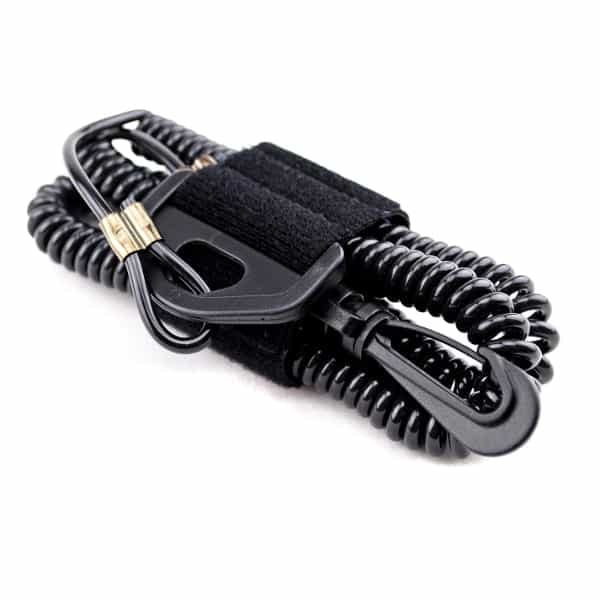
The YakGear coiled paddle leash is one of the sturdiest options on the list. I mentioned earlier how coiled leashes are typically made with stainless steel, which means that recoil isn’t always the best.
However, the YakGear coiled paddle leash solves this issue by skipping the stainless steel and using a solid rubber that stretches much better. There’s no steel at all, but what is called a “full memory coil.”
Pros
This leash provides great recoil thanks to being made from rubber and not steel
The fully memory coil works well to keep the leash in shape
This model isn’t bulky at all, which means it’s easier to handle
It has a fantastic price point, especially considering the quality you get
The leash is lightweight, even in water, so it doesn’t hinder movement at all
It’s excellent quality, so it will last season after season
I find the two feet coiled and five feet uncoiled to be plenty long enough
It’s easy to install and also comes with instructions, just to make sure everything is clear
Cons
You may want something with more reach if five feet isn’t enough for you to comfortably maneuver. But for us it’s enough especially with solid rubber coiled with no wire which permits the extension without being damaged.
Let see a quick demo for the YakGear Coiled Paddle Leash.
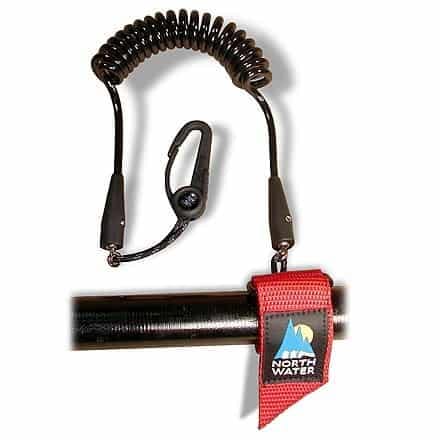
This North Water leash is a typical coiled leash. It stretches from one and a half feet to five and a half feet, and it includes a clip and hook-loop-strap for the paddle itself.
The nice thing about this model is that it has swivels on each side, which prevents kinking and twisting of the coil, which makes it last longer.
I’m also not a big fan of the price of this one. Steel will always be more expensive, but it isn’t as flexible as rubber.
Pros
The swivels on the ends of the leash prevent it from getting twisted, which can extend its longevity and give you more bang for your buck
This model is lightweight at only three ounces, even though it’s steel, so it won’t drag your paddle down or get in the way
The North Water leash has one and a half inches of webbing for the velcro, giving plenty of room to wrap around the paddle itself
The coiled design gives freedom of movement
The urethane material coating prevents absorption of water, which prevents this leash from being weighed down
Cons
The price point isn’t great. While it’s still cheaper than replacing an expensive paddle that costs upwards of $200, there are less expensive models available
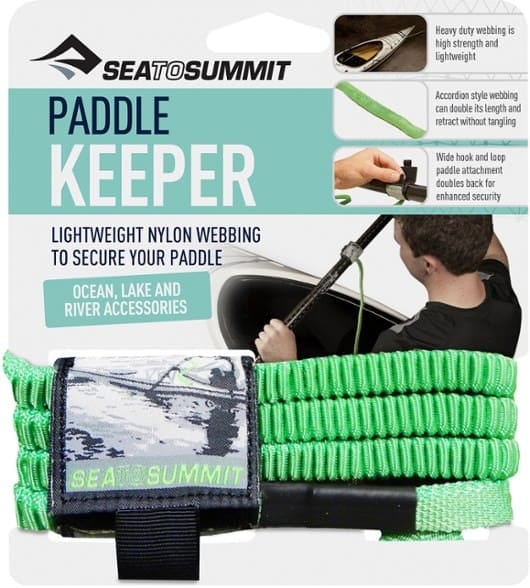
The Sea to Summit paddle leash, or “keeper,” is a lightweight nylon accordion-style webbing that goes from nearly four feet to almost eight. It uses a double hook and loop to attach.
It's heavy-duty, so it can handle even turbulent waters. It’s also more flexible than bungee versions, which means it doesn’t get in the way when I’m out enjoying the water.
One of the best parts of this paddle leash is its bright color, making it easy to see in the water.
Pros
This model has a wide paddle attachment loop, which makes it easier to put on
It’s very lightweight, so it doesn’t weigh me down when I’m kayaking
The nylon is sturdy, and it doesn’t entangle, which no one wants to experience when out on the water
The set up is straightforward, which I appreciate. I like that it doesn’t take twenty minutes to attach
It has a good amount of elasticity, making paddles easy to retrieve
The leash is a high-visibility color, so I can spot my paddle easily when it gets away from me
Cons
Because it’s nylon, it does absorb water. This means not only do I get wet when I use it (not the biggest drawback), but it can get heavier.
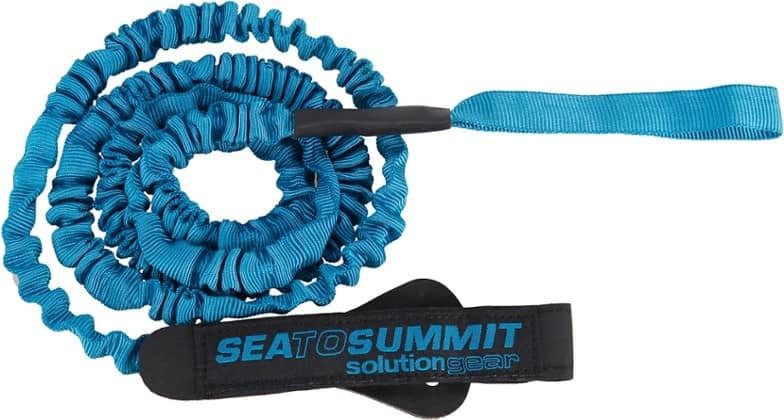
This Sea to Summit leash is a coil with an elastic and rubber center with a nylon coating. It's about three and a half feet when coiled, but it can stretch up to just over six feet long.
At only just over one ounce, it’s about as lightweight as they come. However, you do need to take into account that nylon will soak up water and increase the weight as you use it.
This model uses a loop and velcro to attach to the paddle and kayak, and they’re both sturdy enough to hold up to rough conditions.
Pros
Does not have a steel core, so it’s lighter and less likely to get kinked
The simple design makes it easy to attach
It has a good length, giving a decent amount of reach with each stroke
The material provides excellent elasticity
It has an adjustable attachment point, making it fit a wide range of products
It has a tangle-free design, which is especially important during a capsize event
Cons
Similar to the other Sea to Summit leash, this has a nylon coating. Nylon will soak up water like no one’s business and not only increase weight but get your clothes wet in the process.
While it is easy to attach, it doesn’t come with any instructions.
Everything You Need to Know About Kayak Paddle Leashes
Not all paddle leashes for kayaks are made the same. Some use velcro while others have clips or loops. Whichever you get depends largely on what you want, but there are some universals I think apply to all kayak paddle leashes.
What to Look for in a Leash
The best kayak paddle leash is going to be one that you feel comfortable with. That being said, you’ll likely do well with a model that’s roughly six feet when extended but four feet when coiled. This gives a good reach without bogging you down while you’re boating.
Kayak paddle leashes used to be heavy, bulky, and often got in the way of kayaking. Not today! Now, they're light and maneuverable, so you can use them easily and not feel weighed down.
Straight Cable
A straight cable kayak paddle leash is elastic nylon. Think of something like a bungee cord that will spring your paddle back to you if it gets dropped.
The best part about these kinds of leashes is that you can adjust their length to make them perfect for your reach. If you’re going to be sharing your leash with someone else (perhaps someone whose reach is shorter or longer than your own), an adjustable version may be for the best. This way, it suits everyone’s needs.
Bungee
Bungee leashes are just what they sound like: they're a bungee material that's wrapped in nylon.
They're light, and they stretch as far as you need them to. They're incredibly maneuverable, but they don't recoil to you, which means they can catch on things or drag down in the water.
Do be careful with bungees. That lack of recoil can be a killer, especially if the leash is on the longer side.
Coiled
If you want something sturdy, it's a good idea to look at coiled leashes. They're made out of stainless steel and typically have some sort of covering.
Unlike the bungee model, these will recoil fast, which means they won't weigh you down as you kayak. However, they aren't as stretchy as the straight cable, seeing as they're made with stainless steel (which has absolutely no give itself).
How Do I Attach a Leash?
Each kayak paddle leash is going to attach differently.
However, one side usually clips or loops on to the kayak. I prefer clipping or looping it to the kayak itself, rather than my vest, just in case I flip when I’m out enjoying the water. It’s just easier to swim and maneuver without navigating with a paddle attached to my wrist.
Once one side is attached to the kayak, it’s time to attach the other end of the leash to the paddle itself. Some paddle leashes have a loop that you can put on your paddle by taking it apart and sliding it on before putting it back together.
Other leashes use velcro to wrap securely around the paddle. Like I said: it’s incredibly easy to put the leash on. Now let’s talk about why I think every kayaker needs one.
Why Do Kayakers Need a Paddle Leash?
If you've been kayaking for any length of time, you likely know the trauma of losing a paddle. It's an expensive loss and one that’s entirely avoidable.
But paddles are so easy to lose. Capsizing happens, but so do distractions. If you're out fishing or taking pictures, you'll want access to both of your hands. With a leash, you don't need to worry about your paddle. You can set it down and know it's not going anywhere.
Even Yellowstone national park recommends them as part of any kayaker’s gear! In fact, the National Park Services suggest using a leash even when you’ll be out paddle boarding, to keep all paddles secure, no matter the conditions.
Paddle leashes are also much more affordable than other kayaking equipment, but they offer high value. Many are less than $20, which means they're an inexpensive investment that can save every kayaker hundreds in the long run.
Plus, leashes aren't what they used to be. They don't weigh me down, and they give me the security I need to fully relax while kayaking.
As you noticed, you can do your own, and find many ideas on the net how to do it. But for me, I am lazy, not in a wrong way but in the way to make the thing well done as quickly as possible.
Final Words For The Best Kayak Paddle Leash
The clear winner in my eyes is the YakGear coiled paddle leash. The rubber core doesn't weigh the leash down like steel, and it's more flexible than other coil models.
The price is great, especially considering it can save hundreds over a lost paddle. However, I really appreciate the lack of nylon. This coiled leash doesn't soak up water, so it doesn't get weighed down, and I don't want to worry about getting soaked (unless I capsize, but that's not the leash's fault).
If you have a bigger budget, however, the North Water Coiled Paddle Leash might be a great alternative. For a lightweight and affordable option, try the Sea to Summit Paddle Keeper.
When I need a paddle leash, the YakGear is what I grab on my way out the door.
We hope this review was able to help you choose the best paddle leash ! For any questions or suggestion, we’d love to hear from you below! We reply within 24 hours.
Related Buying Guides
Looking for tested picks? These hands-on guides go deeper on the gear in this article.
![Best Kayak Paddle Leash [Version 1]](/images/2020/10/ACK-Bungee-Paddle-Leash.png)