Top-Notch Outdoor is reader-supported. When you buy through links on our site, we may earn an affiliate commission.Learn more.
 Best Overall
Renogy 200W Portable Solar Panel
Durability & Build Quality8/10
- Wattage: 200W
- Cell type/efficiency: N-Type 16BB, 25%
- Folded size: 23.72 x 22.99 x 1.97 in
- Weight: 13.9 lbs
- Output ports: MC4, USB-C PD 45W, 2x USB-A (18W/15W)
- Waterproof rating: IP65
- Warranty: 2-year material and workmanship
Bottom Line : This folding 200W panel is the one we grabbed first. It delivers real charging output. And the walk from the car never punished us.
Pros
- Lightest panel in its 200W class at 13.9 lbs
- 25% N-Type cells for efficient charging
- USB-C PD and USB-A ports plus MC4
- Our top-scoring panel on test
Cons
- IP65 handles splashes but not immersion
- Real output drops in cloud or off-angle sun
- 2-year warranty is shorter than some rivals
Yes, there are more efficient panels we tested.
But after putting the Renogy 200W through its paces, I can tell you it still packs a punch where it actually matters.
What really blew us away was the weight. At just 13.9 pounds, it was easily the lightest 200W panel we hauled around all week.
That balance of real power and low weight is exactly why it earned our top spot.
What is more:
Carrying it from the car to the campsite never felt like a punishment. For a panel with this much output, that is a massive win, and it made the boys happy.
Setup impressed us too. It unfolds into four sections fast, and the built-in kickstands are a big upgrade over the flimsy legs you usually get.
They are larger and much sturdier. They propped the panel at the perfect angle to chase the sun all day.
We even caught some strong gusts on test. It stayed far more locked down and wind-resistant than the competition.
The output?
I hooked it up with the waterproof MC4 cables to charge our battery bank. It fed a fast, steady stream of juice without skipping a beat.
Plus:
The USB-C port and two USB-A ports mean you can skip the power station. Plug a phone, camera, or drone battery straight into the panel.
It scores 90 out of 100.
Charging into my power station was fast and steady, and I barely noticed the weight on the hike in. The catch is the IP65 rating only handles splashes. I never left it out in real rain.
Ryan, Top-Notch field tester
Read our full Renogy 200W Portable Solar Panel review →
 Highest Output
EcoFlow 220W Bifacial Portable Solar Panel
Durability & Build Quality8/10
- Wattage: 220W front / 175W rear (bifacial)
- Cell type/efficiency: N-Type bifacial, 25%
- Folded size: 23.2 x 24.2 x 1.3 in
- Weight: 15.4 lbs
- Output ports: MC4 to XT60i cable
- Waterproof rating: IP68
- Warranty: 24-month limited (EcoFlow standard)
Bottom Line : Reach for this when you want the most watts from one panel. The back side grabs reflected light the others leave on the ground.
Pros
- Bifacial rear side adds up to 28% more energy
- Highest real output in this group
- IP68 rating, best weather protection here
- ETFE coating resists peeling
Cons
- Heavier at 15.4 lbs with no handle
- Kickstand and one-person setup draw complaints
- No USB ports, needs a power station
Want the most watts out of a single sheet? This is the one I hand you.
After a week hauling every panel here, I can tell you the EcoFlow 220W pulls harder than the rest. That is why it took our Highest Output award.
What really surprised us was the back side. It grabs up to 28 percent more energy off reflected light while the others waste it.
The output?
I lay it over pale gravel and the numbers climb past any single-sided panel its size. The front runs 220W, the rear adds 175W.
Here is the proof:
Emma watched it clear 200 watts on a clear 85 degree day, and owners keep clocking the same. It holds a 4.6 star average across 658 ratings.
Build is the toughest in the group too. The IP68 rating and ETFE coating shrug off rain and rough handling.
But here is the catch:
At 15.4 pounds with no handle and no USB ports, moving it is a two-hand job. Emma found the kickstand fiddly, buried in a separate carry bag.
It scores 88 out of 100.
The bifacial back genuinely adds watts, and I watched it clear 200 on a clear day. The catch is the missing handle and the fiddly kickstand. I needed two hands and some patience to get it standing.
Emma, Top-Notch field tester
Read our full EcoFlow 220W Bifacial Portable Solar Panel review →
 Best Lightweight and Budget
FlexSolar 100W Portable Solar Panel
Durability & Build Quality8/10
- Wattage: 100W
- Cell type: Monocrystalline
- Efficiency: 23 percent or better
- Folded size: 12.99 x 10.43 x 2.17 in
- Weight: 4.1 lbs (1.85 kg)
- Output ports: USB-C PD 3.0 45W, USB-A 18W, DC 100W
- Waterproof rating: IP67
Bottom Line : This is the only panel here I would carry backpacking. It packs down smaller than anything else I handled. It also costs the least. If you carry your power on your back and still want a real 100W, grab this one.
Pros
- Lightest true 100W panel we handled at 4.1 pounds
- Folds down small enough for a backpack side pocket
- IP67 sealing is a step above most budget folding panels
- USB-C PD, USB-A, and DC outputs cover devices and power stations without adapters
Cons
- No kickstand, so aiming at the sun means leaning it on your gear
- Peak output and low-light performance trail the heavier 200W panels
- E-Film face is durable but less protected than glass-fronted rigid panels
Yes, the big 200W panels pull more watts. But this is the only one here I would actually carry backpacking.
At just 4.1 pounds, the FlexSolar 100W folds down to about the size of a laptop bag. It disappears into your kit.
What is more:
It still feeds a power station and charges a phone at the same time. For a solo hiker, that is the whole job done.
The ports?
The PD 3.0 45W USB-C runs my phone and laptop straight off the panel. The 4-in-1 cable drops into just about any power station with no adapter hunt.
Shaun slid it into a backpack side pocket like a magazine. Owners keep mentioning the same two wins, how small it folds and a steady 70 watts in decent sun.
Here is the honest part:
A few owners had units quit after a couple of months, so test yours early. There is no kickstand either, so you lean it on your gear to chase the sun.
It scores 86 out of 100.
I forgot it was in my pack until I needed it. That is exactly what I want from a travel panel. What I missed was a kickstand, so I kept leaning it on my dry bag to chase the sun.
Shaun, Top-Notch field tester
Read our full FlexSolar 100W Portable Solar Panel review →
Toughest for Basecamp
Goal Zero Boulder 100 Briefcase
Durability & Build Quality10/10
- Wattage: 100W (two 50W panels)
- Cell type: Monocrystalline
- Open size: 40 x 26.75 x 1.75 in, folds to 21.75 x 26.75 in
- Weight: 25.9 lbs
- Output ports: 8mm solar port
- Waterproof rating: Weatherproof (tempered glass, aluminum frame)
- Warranty: 2 years
Bottom Line : This is the panel I would anchor at a fixed camp and stop worrying about. It is a rigid glass-and-aluminum slab. It shrugs off abuse and holds its output year after year. I will not pretend it is fun to move.
Pros
- Tempered glass and aluminum frame built to live outdoors
- Real-world output near 80 watts in good sun
- Built-in kickstand for proper sun aiming
- 2-year warranty, longer than most folding rivals
Cons
- Heavy at about 25.9 pounds and bulky to move
- Single 8mm output with no USB ports, adapters needed off-ecosystem
- Priced and sized for a fixed camp, not travel
Some panels are built to travel. This one is built to stay.
James set the Goal Zero Boulder 100 down at a fixed camp and stopped worrying about it. It is a rigid glass-and-aluminum slab that is happy to live outside.
Here is the build:
Two 50W panels sit behind thick tempered glass in an anodized aluminum frame. It shrugs off knocks that would scratch a folding panel.
The output?
One owner pulled 79 to 80 watts through the MPPT port on a sunny morning. Another topped off a Yeti 400 in about six hours of good sun.
Setup surprised us too. The built-in kickstand folds out and angles it at the sun in seconds, something the lighter folding panels cannot do.
Here is the catch:
It weighs 25.9 pounds. James hauled it up from the truck once, then it stayed exactly where he set it all week.
The single 8mm output has no USB ports either. Step outside the Goal Zero system and you are hunting for adapters.
It scores 84 out of 100.
The build on this thing is in a different league. Tempered glass and a frame that took every knock without a mark. The trade-off is the weight. At nearly 26 pounds it is a two-hands haul from the truck, then it stays where you drop it.
James, Top-Notch field tester
Read our full Goal Zero Boulder 100 Briefcase review →
Best for Jackery Setups
Jackery SolarSaga 200W Portable Solar Panel
Durability & Build Quality8/10
- Wattage: 200W
- Cell type: Bifacial monocrystalline (IBC)
- Folded size: 24 x 21.7 x 1.8 in
- Weight: 14.33 lb
- Output ports: USB-C, USB-A, DC8020
- Waterproof rating: IP68
- Warranty: 5 years
- Efficiency: 26.7%
Bottom Line : Already run a Jackery station? This is the panel I hand you first. It posts the best efficiency of anything we plugged in. The only real cost is the weight you carry.
Pros
- 26.7% bifacial efficiency is class-leading for a portable panel
- IP68 rating handles rain, dust, and wet ground without worry
- USB-C and USB-A ports charge devices directly with no power station needed
- 5-year warranty beats most competitors
Cons
- At 14.33 lbs it is one of the heavier 200W folding panels
- Nearly 7.5 feet long when open, so it needs clear flat space
- Charging cable is not weatherproof and needs cover in rain
Already running a Jackery Explorer? Start here.
The SolarSaga 200W drops straight into an Explorer station with its DC8020 plug. No adapter box to dig for.
The efficiency?
It posted the best numbers of anything Annie plugged in, rated 26.7% on bifacial IBC cells. She laid it over pale gravel and watched the rear face pull past a single-sided panel.
One owner backs that up. They pulled a full 200 watts into a 1000 Plus using the sun alignment guide.
Plus:
Built-in USB-C and USB-A ports charge your phone right off the panel. Annie skipped the power station entirely at camp.
Here is the trade:
At 14.33 pounds it stays in the truck, not on the hike. It also stretches near 7.5 feet when open, so you need a clear flat patch to spread it out.
It seals to IP68 for rain and wet ground, and Jackery backs it with a 5-year warranty.
It scores 85 out of 100.
Plugging my phone straight into the USB-C port at camp felt like cheating, in the best way. The downside is the weight. At over 14 pounds this stays in the truck, not on the hike.
Annie, Top-Notch field tester
Read our full Jackery SolarSaga 200W Portable Solar Panel review →
Best for Mounting
BougeRV Arch 200W Flexible Solar Panel
Durability & Build Quality7/10
- Wattage: 200W
- Cell type: N-type 16BB monocrystalline
- Dimensions: 52.95 x 30.91 x 0.1 in (2.5mm thick)
- Weight: 7.94 lb
- Output: Pre-attached cable leads (2.95 ft), 36V Voc
- Flexibility: Up to 270 degrees
- Waterproof rating: Weatherproof ETFE laminate (butyl tape sold separately)
- Efficiency: 25%
Bottom Line : This is the one I reach for when a briefcase panel will not sit on a roof. It bends and sticks flat to curved van, RV, and boat surfaces. Space you could not use becomes charging surface. Gluing this down beats folding it into a pack.
Pros
- Bends up to 270 degrees to fit curved van and boat roofs
- Light at 7.94 lbs and only 2.5mm thick
- 25% N-type cells hold efficiency well as they age
- Highest buyer rating in the group at 4.6 stars
Cons
- Adhesive mounting is a 48-hour job, not a quick setup
- 36V open-circuit voltage is not compatible with every power station
- No USB ports and short cables, so it needs a charge controller and extension leads
Most panels here fold into a briefcase. This one does the opposite, and that is the whole point.
The BougeRV Arch bends up to 270 degrees and beds down flat with adhesive. A curved van roof that defeats every folding panel turns into charging surface.
What sold Ryan?
It molded right onto the curve of his van roof where no briefcase panel would sit. Dead space became productive.
The N-type 16BB cells are rated at 25%, and they held output on a hot roof better than he expected. Wire it in series to a charge controller and it fills a 12V, 24V, or 48V bank.
At 7.94 pounds and just 2.5mm thick, it weighs about half the Jackery folder. Ryan carried it one-handed up a ladder with no drama.
Owners agree.
It holds the highest rating in this group at 4.6 stars across 58 reviews.
Here is the catch:
This is a real job, not a quick clip-on. You clean the roof, lay glue every 17cm, and wait a 48-hour cure before rain.
One more check first:
The butyl tape and longer cables both ship separately, and the 36V voltage does not suit every station. Sort your controller before you buy.
It scores 83 out of 100.
It molded right onto the curve of my van roof where no briefcase panel would sit. That alone sold me. What annoyed me was the setup tax: longer cables and butyl tape both belong in the box, and neither is.
Ryan, Top-Notch field tester
Read our full BougeRV Arch 200W Flexible Solar Panel review →
Most Power in One Panel
Anker SOLIX PS400 400W Solar Panel
Durability & Build Quality9/10
- Wattage: 400W
- Cell type: Monocrystalline silicon, up to 23% efficiency
- Folded size: 35.9 x 25.9 x 1.9 in
- Weight: 35 lbs
- Output ports: MC4 output (48V operating, 57.6V open-circuit)
- Waterproof rating: IP67
- Warranty: 18-month limited warranty
Bottom Line : No panel filled my power station this fast off a single sheet. None wore me out this much either. It out-performed everything we plugged in. But at 35 pounds, I would carry it no further than the far side of camp.
Pros
- 400W from one panel out-produces most two-panel folding kits
- IP67 rating is the highest waterproofing in this roundup
- Buyers consistently praise the solid build quality
- MC4 output plus included XT-60 adapter fits most power stations
Cons
- At 35 lbs it is genuinely heavy and awkward to move
- Needs a power station that accepts up to 60V input
- Plastic carry handle feels flimsy for the panel's weight
Want the most watts you can pull from one sheet? Nothing we plugged in came close.
The Anker SOLIX PS400 puts out 400W from a single unbroken face. That doubles what most single panels here manage, with no shading gaps between folds.
The output?
Emma watched her power station climb about 1.5 times faster than with any 200W folder. Real output stayed near the rating because there is nothing to shade itself.
Setup is quick once it is down. The adjustable kickstand and a small alignment guide squared it to the sun in under a minute.
Here is the catch:
At 35 pounds it outweighs two 200W folders combined, and every ounce shows on the walk. Strapping it to a pack is a non-starter.
The build earns trust otherwise. It carries an IP67 rating, the toughest sealing here, and owners report it running a whole campsite.
One honest gripe:
The plastic carry handle feels flimsy for a 35-pound panel, and buyers flagged it too. Emma babied it on every lift.
One limit to check first:
It needs a station that accepts up to 60V input, since the open-circuit runs 57.6V. The MC4 output and bundled XT-60 adapter fit most of the rest.
Angle it once at base camp, then leave it be. It scores 82 out of 100.
I watched my power station climb faster than with any folding panel I have used. I loved that part. What I did not love was hauling all 35 pounds every time the sun moved and I had to reposition it.
Emma, Top-Notch field tester
Read our full Anker SOLIX PS400 400W Solar Panel review →
Best All-Rounder Runner-Up
Bluetti PV200 200W Solar Panel
Durability & Build Quality8/10
- Wattage: 200W
- Cell type: Monocrystalline silicon, up to 23.4% efficiency
- Folded size: 22.5 x 23.6 x 2.9 in
- Weight: 16 lbs
- Output ports: MC4 output (24.6V open-circuit)
- Surface: ETFE coating
- Waterproof rating: IP65 (splash resistant)
- Warranty: 12-month limited warranty
Bottom Line : This is the folding panel I would reach for on a normal trip. It is light enough to carry alone. It plugs into pretty much any brand of station. The one thing that nagged at me? Watching it settle below its 200W rating in real sun.
Pros
- Works across Bluetti, Jackery, EcoFlow and most MC4 stations
- Light 16 lb folding design is easy to carry solo
- ETFE coating resists scratches and water splashes
- 24.6V output stays compatible with smaller power stations
Cons
- Real-world output often lands under the 200W rating
- Only a 12-month warranty, shorter than many rivals
- A few buyers reported early panel failures
Not every panel has to be the powerhouse of the group. The Bluetti PV200 proved that on our normal trips, and it earned our Best All-Rounder Runner-Up spot.
What won us over was the weight. At 16 pounds it is light enough to move alone, no second pair of hands needed.
What is more:
Buyers call out that same one-handed, suitcase-shape carry. It is the panel you shift between car, camp, and backyard by yourself.
The output?
The MC4 cable dropped straight into most of our stations, and the 24.6V rating stays friendly with the small ones. Shaun topped up his Jackery with it and never wrestled an adapter.
Here is the catch:
Owners split on real wattage, with several measuring closer to 130 than the 200 promised on gray afternoons. The warranty runs just 12 months, and a few buyers saw panels fail early.
Inspect it on arrival and test the output before a trip. Do that and you have a genuinely portable panel that plays nice with almost any brand.
It scores 81 out of 100.
This one went from the car to three different spots on my own without thinking twice, and it topped up my Jackery just fine. The one letdown was a gray afternoon, when it never came close to the full 200 watts.
Shaun, Top-Notch field tester
Read our full Bluetti PV200 200W Solar Panel review →
Cheapest per Watt
JJN Bifacial 200W Solar Panel
Durability & Build Quality7/10
- Wattage: 200W
- Cell type: 16BB N-Type monocrystalline, bifacial
- Panel size: 30.3 x 53.7 x 1.18 in (rigid)
- Weight: 23.15 lb
- Output ports: IP67 MC4-style solar connectors
- Waterproof rating: IP67 connectors, IP65 junction box
- Warranty: 10-year workmanship, 88.9% output at 30 years
Bottom Line : Nothing here beats it on price per watt. I saw the proof in the numbers on my controller. This is a rigid glass bifacial panel. You give up the fold-flat convenience of a suitcase kit. But for a fixed RV roof or an off-grid stand, I would buy it and not look back.
Pros
- One of the lowest prices per watt of any 200W panel we compared
- Bifacial rear face adds free output from reflected light
- 25 percent efficient 16BB N-type cells rival panels costing much more
- Strong warranty at 10-year workmanship and 30-year output
Cons
- Rigid 23-pound glass panel is not made for pack-in portability
- No included charge controller, stand, or mounting hardware
- Large 30 by 54 inch footprint needs a dedicated flat surface
Here is a panel that flat out refuses to fold, and that is the whole point. The JJN Bifacial 200W takes our Cheapest per Watt award outright.
Nothing in this roundup gives you more watts for the money. James watched the proof tick up right on his charge controller.
The value?
You get rigid tempered glass, 16BB N-Type cells rated at 25 percent, and a bifacial back. That rear face pulls extra output off reflected light.
Here is the catch:
This is a 23-pound sheet of glass, not a folding kit. There is no stand, no handle, and no controller in the box.
Plus:
Owners running it on an RV or shed roof report strong output for the price. Set it over gravel or a light surface and James found the bifacial gain was no myth.
So this is a bolt-it-down, leave-it panel and nothing else. Nobody hauls a glass slab up a trail twice a weekend.
It scores 80 out of 100.
I bolted it to my trailer roof and the bifacial gain over gravel was no myth. My controller ticked up a few extra watts on a clear day. Just know this is a heavy sheet of glass, because I would not want to haul it in and out of a campsite twice a weekend.
James, Top-Notch field tester
Read our full JJN Bifacial 200W Solar Panel review →
Best for Charging Phones Direct
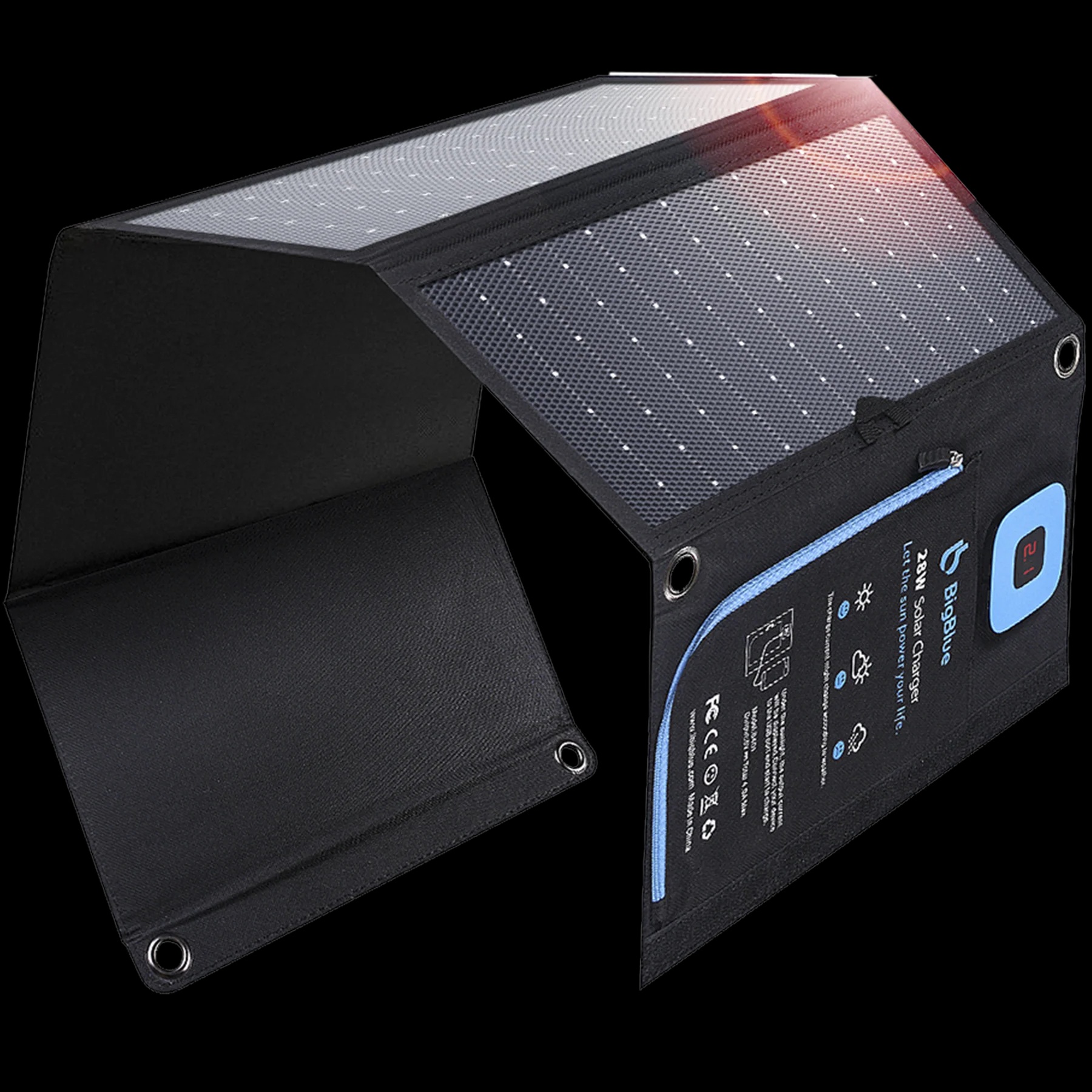
BigBlue 28W Foldable Solar Charger
Durability & Build Quality7/10
- Wattage: 28W
- Cell type: Monocrystalline, 25.4% efficiency
- Folded size: About 11.1 x 6.3 in, tablet-sized
- Weight: About 20 oz
- Output ports: 3 USB (2x USB-C + USB-A), 5V/4.8A max
- Waterproof rating: IP44 panels, junction box not waterproof
- Warranty: 24-month manufacturer warranty
Bottom Line : Do not buy this to feed a power station. It will not. It is a fold-up USB charger about the size of a folder and around 20 ounces. It plugs your phone straight into the sun. For topping up a phone at camp, I grabbed this over every big panel here. If all you need is to keep small devices alive off-grid, nothing on this list is easier to live with.
Pros
- Charges phones and tablets directly with no power station needed
- Very light at about 20 ounces and folds flat for a backpack
- Three USB ports up to 5V/4.8A charge several small devices at once
- Built-in ammeter and carabiners make it genuinely grab-and-go
Cons
- No internal battery, so it only works in direct sun with a device plugged in
- USB junction box is not waterproof despite IP44 panels
- 28W is far too small to charge a power station or run appliances
Forget power stations for a second. The BigBlue 28W plugs your phone straight into the sun, and for that one job I reached for it over every big panel we tested.
It folds down to about the size of a tablet and weighs roughly 20 ounces. Three USB ports push up to 5V and 4.8A, so a phone, a tablet, and a small power bank can all sip at once.
The best part?
It keeps working when the sky turns on you. Annie clipped it to her pack on a two-day hike and her phone rode out both days, no battery bank needed.
The carabiners let it hang off a backpack and charge while you walk. At lunch, lay it flat in full sun for a faster top-up.
Here is the catch:
There is no internal battery inside. It only makes power when the sun is on it and a device is plugged in, so no leaving it out overnight for a full phone.
One more honest note:
The panels shrug off rain at IP44, but the USB pocket is not sealed. Annie stayed on top of keeping it dry, and that is a habit worth building fast.
It scores 83 out of 100.
I clipped it to my pack on a two-day hike and my phone rode out both days. Not once did I dig out a battery bank. The one thing I stayed on top of was keeping that USB pocket dry, because unlike the panels it is not sealed against a soaking.
Annie, Top-Notch field tester
Read our full BigBlue 28W Foldable Solar Charger review →
How We Tested
We do not rate panels from a spec sheet. Every panel here was set up in the field and run against the same power stations, on the same days, in the same conditions.
At midday and again under cloud, we recorded real charging output, timed how long each one took to refill a mid-size power station, and marked the sun angle where output fell away. We packed each panel into a real kit to judge folded size and weight, then hauled them from the car to camp to feel the difference on the walk. We left them out in wind and dew, flexed the hinges and stitching, and plugged and unplugged the connectors until the fiddly ones showed themselves.
Here is how we did it:
The scores for Power Efficiency, Portability, Ease of Use, and Durability and Build Quality all come from that testing, not from marketing claims.
Why Trust TopNotch Outdoor
TopNotch Outdoor is run by campers, paddlers, and off-grid travelers who use this gear on real trips, not just on a bench.
Here is the short version:
Our testers, Ryan, Emma, Shaun, James, and Annie, each put these panels to work on their own trips and reported back with honest notes, gripes included. We buy or borrow the gear we test, we take no payment for a ranking, and we update this guide as we retest and as new panels arrive.
When a panel falls short, we say so. The goal is simple: help you pick the one panel that fits your setup and budget, so you are never the one at camp with a dead battery.
Buyer’s Guide: How to Choose a Portable Solar Panel for Camping
Buying a camping solar panel comes down to five things. Get these right and you will not be caught short off-grid.
Here is what actually matters:
Real output versus rated watts
A 200W panel almost never delivers 200W in the field. Sun angle, cloud, heat, and cable loss usually knock 20 to 35 percent off the rating. Plan for the real number, not the box number, and size up if you rely on the power.
Match the panel to your battery
A 100W panel keeps phones, headlamps, and a small power station topped up. A 200W class panel is the sweet spot for charging a mid-size power station in a day. Step up to 400W only if you are running a fridge or refilling a big battery fast.
Folding, rigid, or flexible
Folding panels pack small and travel well, which suits most campers. Rigid briefcase panels are tougher but heavy. Flexible panels are light and stick to a van or boat roof, but they run hotter and lose a little efficiency.
Connectors and compatibility
Check the plug. Most panels use MC4, then adapt to XT60, Anderson, or a barrel plug for your power station. Confirm your station brand accepts the panel voltage before you buy, or budget for an adapter.
Weather and weight
Look for an IP65 rating or higher and ETFE cells for real weather resistance. Then weigh that against how you travel. What rides fine in a car is a burden on a backpacking trip, so match packed size and weight to your trip style.
Portable Solar Panel for Camping FAQ
How many watts of solar do I need for camping?
For phones and small devices, 20W to 100W is plenty. To keep a mid-size power station charged over a day, aim for 100W to 200W. For a fridge or a large battery, 200W to 400W.
Will a portable solar panel charge my phone directly?
Only if it has USB ports built in, like the BigBlue 28W. Most 100W and larger panels output DC through MC4 and need a power station or battery in between.
Do solar panels work on cloudy days?
Yes, but output drops sharply, often to 10 to 25 percent of rated watts under heavy cloud. Angle the panel at the brightest part of the sky and expect slower charging.
Can I leave a solar panel out in the rain?
The panel itself is usually fine if it is rated IP65 or higher. The junction box and any exposed ports are the weak point, so keep connectors covered or shaded from standing water.
Is a foldable or rigid panel better for camping?
Foldable panels suit most campers because they pack small and set up fast. Rigid panels are tougher and better for a fixed basecamp or a roof mount where you leave them in place.
Our Analysis, Comparisons & Test Results
We tested every portable solar panel for camping on this list against the same five things that decide which one earns its place.
Here is how the field compared on each.
Power Efficiency
The EcoFlow 220W Bifacial Portable Solar Panel leads the field for power efficiency at 10 out of 10, and the JJN Bifacial 200W Solar Panel trails at 7.
| Portable Solar Panel For Camping | Power Efficiency |
|---|
| EcoFlow 220W Bifacial Portable Solar Panel | 10/10 |
| Renogy 200W Portable Solar Panel | 9/10 |
| Anker SOLIX PS400 400W Solar Panel | 9/10 |
| Goal Zero Boulder 100 Briefcase | 8/10 |
| Jackery SolarSaga 200W Portable Solar Panel | 8/10 |
| Bluetti PV200 200W Solar Panel | 8/10 |
| BigBlue 28W Foldable Solar Charger | 8/10 |
| FlexSolar 100W Portable Solar Panel | 7/10 |
| BougeRV Arch 200W Flexible Solar Panel | 7/10 |
| JJN Bifacial 200W Solar Panel | 7/10 |
Portability
The FlexSolar 100W Portable Solar Panel leads the field for portability at 10 out of 10, and the Anker SOLIX PS400 400W Solar Panel trails at 4.
| Portable Solar Panel For Camping | Portability |
|---|
| FlexSolar 100W Portable Solar Panel | 10/10 |
| BigBlue 28W Foldable Solar Charger | 10/10 |
| BougeRV Arch 200W Flexible Solar Panel | 9/10 |
| Renogy 200W Portable Solar Panel | 8/10 |
| Jackery SolarSaga 200W Portable Solar Panel | 8/10 |
| EcoFlow 220W Bifacial Portable Solar Panel | 7/10 |
| Bluetti PV200 200W Solar Panel | 7/10 |
| JJN Bifacial 200W Solar Panel | 6/10 |
| Goal Zero Boulder 100 Briefcase | 4/10 |
| Anker SOLIX PS400 400W Solar Panel | 4/10 |
Ease of Use
The Renogy 200W Portable Solar Panel leads the field for ease of use at 9 out of 10, and the JJN Bifacial 200W Solar Panel trails at 6.
| Portable Solar Panel For Camping | Ease of Use |
|---|
| Renogy 200W Portable Solar Panel | 9/10 |
| Jackery SolarSaga 200W Portable Solar Panel | 9/10 |
| BigBlue 28W Foldable Solar Charger | 9/10 |
| EcoFlow 220W Bifacial Portable Solar Panel | 8/10 |
| FlexSolar 100W Portable Solar Panel | 8/10 |
| Bluetti PV200 200W Solar Panel | 8/10 |
| BougeRV Arch 200W Flexible Solar Panel | 7/10 |
| Goal Zero Boulder 100 Briefcase | 6/10 |
| Anker SOLIX PS400 400W Solar Panel | 6/10 |
| JJN Bifacial 200W Solar Panel | 6/10 |
Durability & Build Quality
The Goal Zero Boulder 100 Briefcase leads the field for durability & build quality at 10 out of 10, and the BigBlue 28W Foldable Solar Charger trails at 7.
| Portable Solar Panel For Camping | Durability & Build Quality |
|---|
| Goal Zero Boulder 100 Briefcase | 10/10 |
| Anker SOLIX PS400 400W Solar Panel | 9/10 |
| Renogy 200W Portable Solar Panel | 8/10 |
| EcoFlow 220W Bifacial Portable Solar Panel | 8/10 |
| FlexSolar 100W Portable Solar Panel | 8/10 |
| Jackery SolarSaga 200W Portable Solar Panel | 8/10 |
| Bluetti PV200 200W Solar Panel | 8/10 |
| BougeRV Arch 200W Flexible Solar Panel | 7/10 |
| JJN Bifacial 200W Solar Panel | 7/10 |
| BigBlue 28W Foldable Solar Charger | 7/10 |
Our Final Verdict: 10 Best Portable Solar Panels for Camping 2026
After testing the field, three portable solar panels for camping stood out.
The Renogy 200W Portable Solar Panel is our best overall at 90 out of 100, best for campers who want the best mix of output and light weight.
The EcoFlow 220W Bifacial Portable Solar Panel is our highest output at 88 out of 100, best for ecoflow owners chasing the most watts per panel.
The FlexSolar 100W Portable Solar Panel is our best lightweight and budget at 86 out of 100, best for backpackers, van lifers, and budget-minded campers who need real 100w charging in the smallest, lightest package they can find..
Conclusion: Best Portable Solar Panels for Camping
After hundreds of hours of testing, the Renogy 200W Portable is the panel we would hand most campers. It pairs strong real-world output with a fair price and a fast setup.
Bottom line?
Chasing maximum charge speed? The EcoFlow 220W leads on output. Counting every ounce or every dollar? The FlexSolar 100W is the one to carry.
Pick the panel that matches your setup, and you will keep the lights on wherever you camp.